Recently, Korea’s Supreme Court delivered a landmark ruling in a trademark infringement case between Louis Vuitton and a reform service provider. The Supreme Court overturned the lower courts’ decisions that had sided with Louis Vuitton and sent the case back to the Patent Court for review.
The defendant had been operating a reform business since 2017, deconstructing clients’ Louis Vuitton bags and using the original materials to create new items like wallets and smaller bags, charging between $80 and $550 per piece. Louis Vuitton filed a lawsuit in February 2022, claiming trademark infringement.

The Supreme Court ruled that providing reform services for items received from owners for “personal use” does not constitute “use of a trademark” under trademark law. However, the court clarified that if a reformer takes control of the entire process and effectively produces and distributes products in the marketplace as their own goods, it could still constitute trademark infringement.
This ruling marks the first time Korea’s Supreme Court has established legal standards regarding reform services and trademark infringement. The court noted that this case has drawn significant attention from the United States, Europe, Japan, and other countries, emphasizing the importance of the legal principles involved and their substantial social impact.
Jed’s Commentary
Luxury Reform and the Limits of Personal Freedom
This is a complicated issue, but in principle I still side with the luxury brands when it comes to trademark and profit. That said, I am not someone who particularly likes high end luxury brands. In fact, I often think their products are overpriced, and that the quality and even the design do not always justify the price.
There was a time in my life when I was obsessed with leather jackets. My perspective has changed since then. I no longer buy leather products because my views on animals have changed, and now I am honestly satisfied with cheap synthetic leather. But back then, I deliberately visited department stores to examine leather jackets from famous European luxury brands. I wanted to see what made them so expensive.

I was genuinely surprised. The leather quality and the washing process did not seem very different from mid range brands. There was no dramatic difference that could explain the extreme price gap. Later, I realized that truly high quality leather and skilled craftsmanship are often found in small niche brands run by people who are deeply passionate about leather itself. They carefully select specific types of hides, consider the season, and focus intensely on the treatment process from the very beginning. I will not mention any names because I do not want to encourage leather consumption, and I also feel slightly embarrassed about how many leather jackets I used to buy.
From a pure shopping perspective, paying hundreds or even thousands for a leather product from a European luxury house does not make sense to me. I honestly think it is irrational if we judge it only by material quality or technical workmanship.
And yet, despite all this, I still believe that the issue of trademark misuse and profit is separate. We can criticize luxury brands for being overpriced. We can question their value. But that does not mean others have the right to use their brand identity for profit without permission. Even if I personally think buying some of these products is foolish, that does not justify violating property rights.
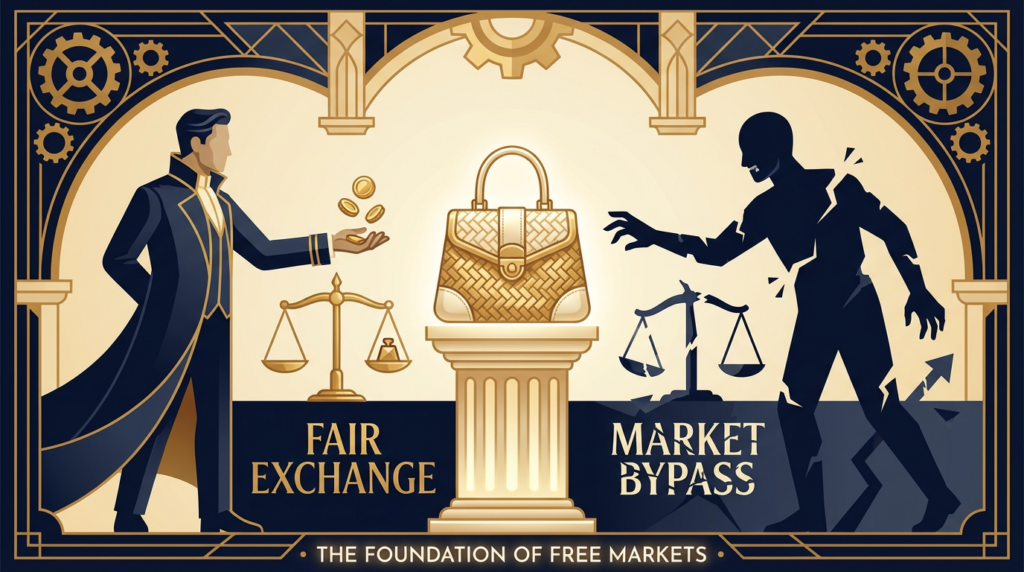
So I do not believe luxury brands exist only because of better design or better quality. In many cases, that is not even the main reason. I think they also serve another function in a capitalist society. They indirectly signal status. Not everyone can own them, and that is precisely why people want them more. When some goods are affordable to all and others are clearly out of reach, people understand how capitalism works. Scarcity and price create visible layers within society. Whether we like it or not, that structure is part of the system.
Look at cars like Lamborghini or Bugatti. Realistically, how many owners fully use their speed and performance unless they go to a race track? Probably very few. The practical function is not the main reason for purchase. The car becomes a symbol. It shows wealth and signals social position.
The same logic applies to watches like Rolex or Hublot. In terms of pure function, a Seiko or a G-Shock can be more durable and practical. Many luxury watches are less shock resistant and less useful for daily wear. Yet people still desire them intensely. Even in an age when everyone carries a smartphone, some wealthy individuals wear watches worth the price of a house. That is not about timekeeping. It is about what the object represents inside a capitalist system.

Profit, Property Rights, and the Entitlement Mindset
Because luxury goods play this symbolic role, using their trademarks freely and selling modified versions cheaply is not a small issue. If someone reforms a product for personal use, that is one thing. But making money from someone else’s brand without permission crosses a clear line. That is not creative freedom. It is taking value that does not belong to you.
The argument that “luxury is overpriced, so people should be able to access it cheaply” ignores the structure of capitalism itself. In a market economy, not everyone is meant to have access to everything. Wanting equal access to high end brands while refusing to pay the market price reflects a rejection of private property rights. It is an entitlement mindset. And those who profit by misusing trademarks are not activists or reformers. They are taking someone else’s property for personal gain. If we accept capitalism, we must also accept its boundaries. Otherwise, we are simply choosing the parts we like and discarding the rest.