

Why I Started Speaking on My Own Platforms
One of the main reasons I decided to share my thoughts about Korea and global issues through my blog, YouTube, and Instagram is simple: traditional media no longer performs the role it once did.
Newspapers and broadcast networks used to function as gatekeepers of information. They investigated stories, verified facts, and helped shape serious public discussions. Today, however, many media organizations appear far more concerned with traffic, engagement, and algorithm performance than with maintaining the standards of journalism.
For many readers, including myself, this shift has become increasingly obvious over the past decade. Institutions that once carried authority now seem to be chasing the same attention economy that drives social media.
A good example is BBC, which I used to read quite regularly. Over time I began noticing that its homepage was increasingly filled with entertainment content—especially stories about K-pop and global pop culture. Articles about artists such as BTS and other celebrities began appearing with surprising frequency, often written in ways that clearly aimed to attract clicks rather than provide meaningful journalism.
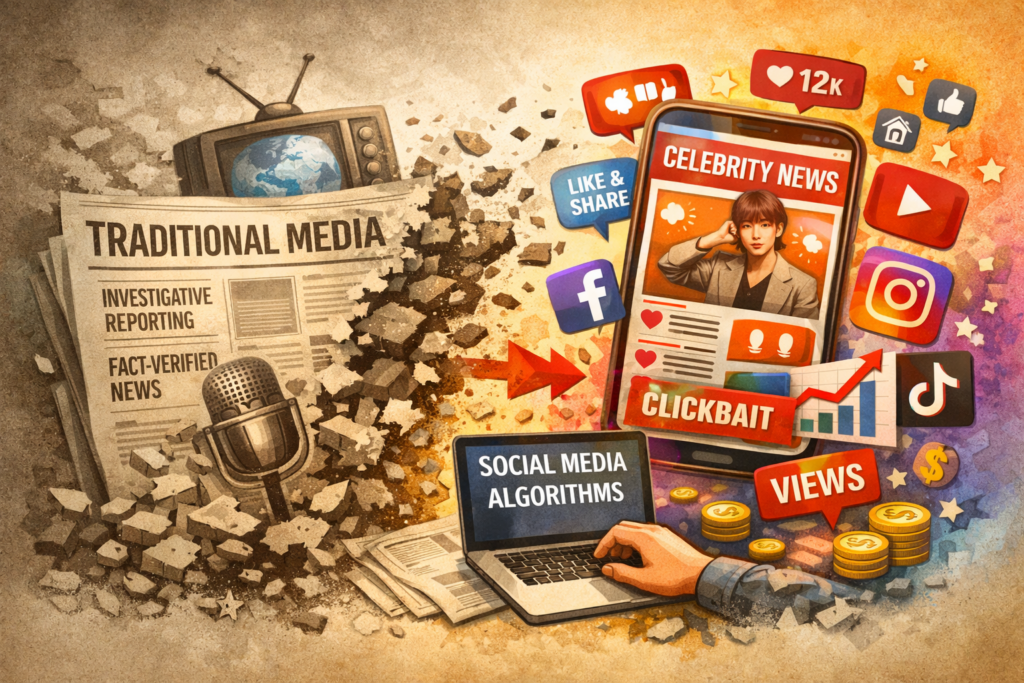
Before anyone gets the wrong idea, let me say this with a bit of humor: I have absolutely nothing against BTS, so please don’t cancel me or bury me alive for mentioning them here. They simply happen to be one of the clearest examples of how global pop culture can dominate online media coverage.
From a business perspective, the logic is obvious. K-pop generates enormous international engagement, especially from younger audiences in regions like Latin America and Southeast Asia. But when major news outlets begin filling large portions of their pages with celebrity content simply because it generates traffic, something fundamental about journalism has changed.
The Attention Economy and the Simplification of Culture
Part of this shift is the natural result of technological change. The internet created a global audience, and media companies now compete in a worldwide marketplace of attention. In this system, the content that travels fastest is not necessarily the content with the most substance.
Historically, global cultural influence often flowed from established cultural centers outward. Western media institutions dominated the international landscape for decades. Some people disliked this system, sometimes associating it with a narrow Western perspective.
But replacing one dominant cultural flow with another does not automatically improve the quality of global culture.
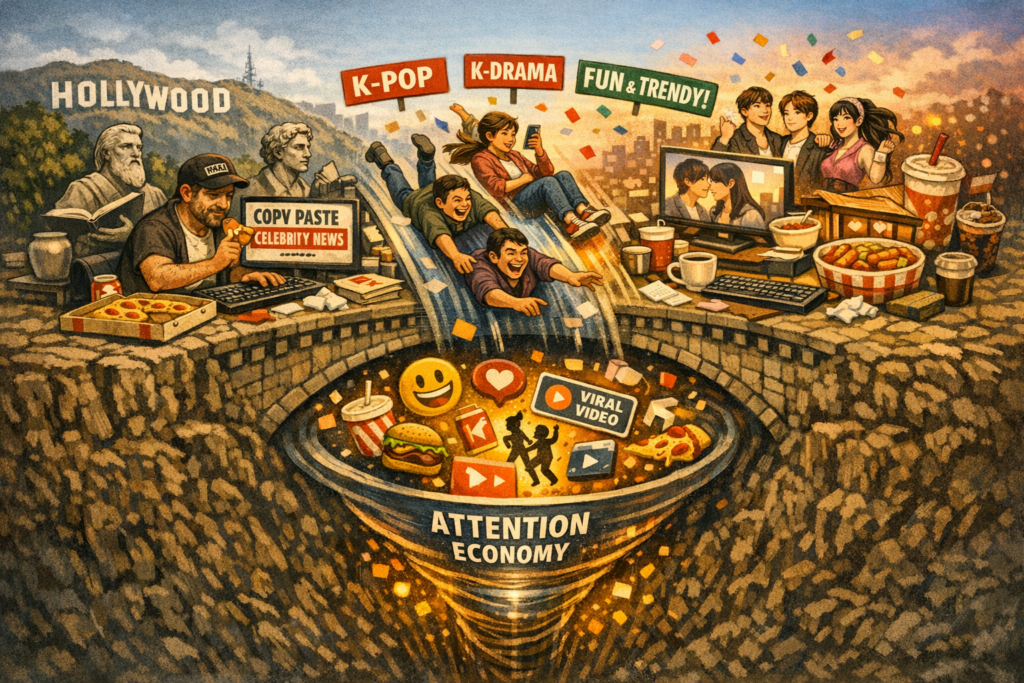
In my personal view, the recent wave of K-culture—K-pop, K-dramas, K-food, and “K-everything” has become one of the most powerful forces shaping the current global entertainment environment. While many celebrate this phenomenon, I sometimes wonder whether it has also contributed to the general simplification of global cultural consumption, where entertainment value increasingly outweighs artistic or intellectual depth.
This is not a criticism of Korea itself. Rather, it is a reflection of how the modern media ecosystem rewards content that is easily shareable, emotionally engaging, and algorithm-friendly.
When Awards Lose Their Meaning
The same pattern can be seen in global film awards.
The movie Parasite won Best Picture at the Academy Awards in 2020, becoming the first non-English-language film ever to receive that award. In Korea, the reaction was explosive. Media outlets treated the news as a national triumph.
But there is a very simple question that reveals something interesting about modern award culture.
How many of the people celebrating that victory could name the Best Picture winners from the year before and the year after?
The winners were Green Book in 2019 and Nomadland in 2021. Yet the vast majority of people who celebrated Parasite probably could not name those films at all.
And this leads to an uncomfortable conclusion: if people only care about an award when their own country wins it, the authority of that award may already be fading.
For the record, I should also be honest about my personal taste. I absolutely love Green Book. In fact, I think it is an extraordinary film—one of those rare movies that stays with you long after you finish watching it. Personally, I don’t think Parasite and Green Book belong in the same category in terms of storytelling and emotional depth.

That is, of course, just my opinion, but I genuinely see Green Book as a masterpiece that operates on a completely different level.
As for Nomadland, my reaction was more neutral. It was a decent film, but I couldn’t help wondering whether it won the award partly because it contained the kind of themes and tone that award committees traditionally like. That said, I do have great respect for the film’s lead actress, Frances McDormand, who has delivered remarkable performances throughout her career.
All of this raises a larger point: major awards no longer hold the same universal authority they once did.
Media Following the Audience Downward
A deeper problem lies in the relationship between media organizations and their audiences.
Journalism today operates under severe economic pressure. News organizations must survive financially, and digital advertising often depends on traffic volume. If audiences increasingly click on celebrity gossip, viral scandals, and sensational headlines, many outlets feel forced to adapt their content to match audience behavior.
This creates a downward spiral. As audiences consume more superficial content, media organizations produce more of it. Eventually, even institutions that once represented serious journalism begin to resemble entertainment platforms.
In a strange way, the situation creates an ironic metaphor. Journalism itself starts to behave like a kind of parasite within the attention economy, feeding on whatever content generates the most clicks.
The Situation in Korea
If global journalism is struggling, the situation in South Korea may be even more troubling.
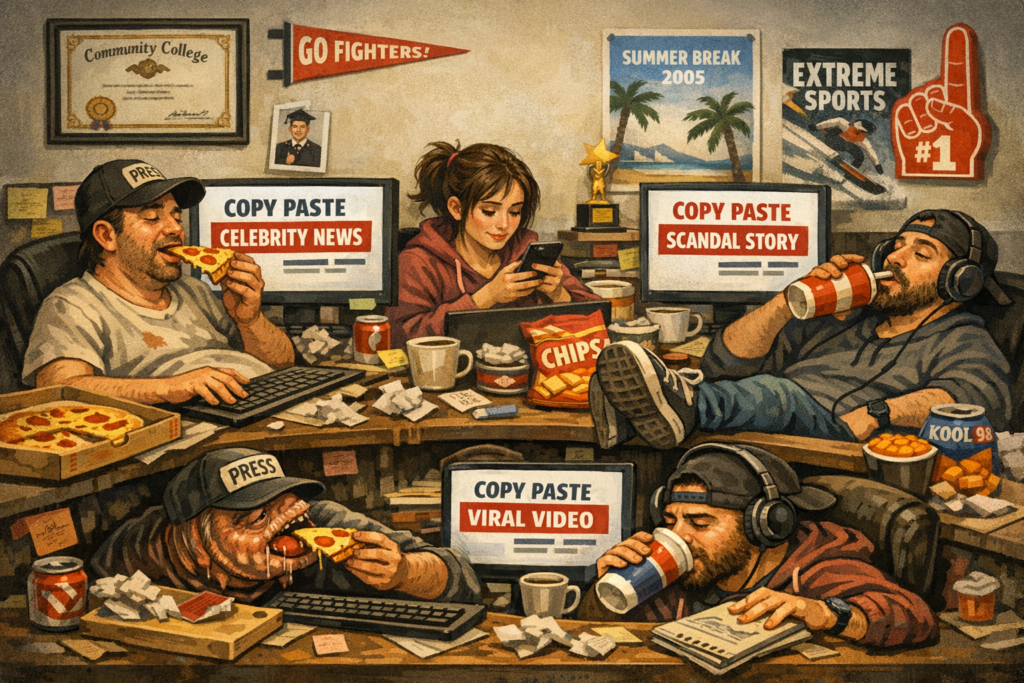
Korean media historically faced structural problems long before the digital era. Many outlets relied heavily on corporate advertising and often functioned partly as promotional platforms for large companies. Entertainment and sports gossip also occupied a large portion of the news environment.
In recent years, however, the quality of journalism appears to have declined even further. It is no longer unusual to see news articles containing basic spelling or grammar errors—something that would once have been unacceptable in professional reporting.
Public frustration has become so intense that journalists are sometimes called “기레기,” a combination of the Korean word for journalist (기자) and the word for trash (쓰레기). It is a harsh label, but it reflects the deep loss of trust between the public and the media.
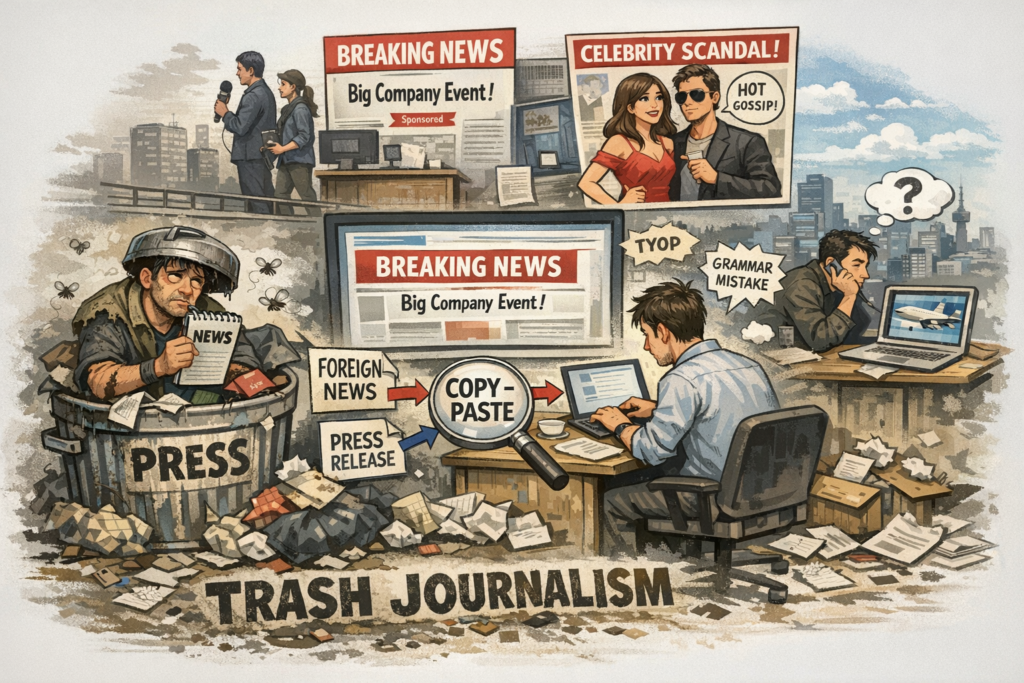
Another problem is the disappearance of traditional reporting. Journalism once required reporters to spend time in the field—meeting people, verifying information, and investigating stories firsthand. Today many articles appear to be little more than translations of foreign news reports, rewritten summaries of other outlets’ work, or corporate press releases published almost unchanged.
In some cases, even those translations contain obvious mistakes. When journalism becomes a process of copying and pasting information rather than gathering it independently, the credibility of the entire profession suffers.
When the Vacuum Is Filled by Others
When traditional journalism loses authority, other voices quickly fill the space.
Some independent commentators and YouTubers provide thoughtful analysis, but many simply chase attention using the same methods that now dominate the media industry. Without strong journalistic institutions acting as filters, misinformation can spread quickly.
Recently someone commented on one of my YouTube videos claiming that Korea is legally a country where women are easily harassed. When I asked where that idea came from, the person said they had heard it from a YouTube video made by a former journalist.
This is exactly the environment that emerges when professional journalism loses its credibility. Once trust disappears, anyone can claim authority.
A Global Problem, Not Just a Korean One
Ultimately, this problem extends far beyond Korea. Across the world, the quality of communication media and news media appears to be declining.
The attention economy rewards speed, emotional reactions, and viral controversy far more than careful reporting or thoughtful analysis. As a result, the overall level of public discussion continues to fall.
This leaves us with a serious question.

Is this really the direction we want global journalism to go?
A media environment dominated by algorithms, celebrity gossip, and viral outrage is not a healthy foundation for democratic societies. Yet that is increasingly the system we are living in today.
And unless something changes, the decline of journalism may continue accelerating.